Welcome to the Queering the Museum site. This site functions as an archive of the Project, our collaboration with MOHAI and the LGBTQ work being done in our field. QTM is no longer active, and we have gone each gone on to pursue new projects. We hope this archive supports the long-term grown of LGBTQ+ representation in museums.
Queer Digital Stories: Identity
Queer Digital Stories: Looking Back This post is the third in a series written by participants of our queer digital storytelling workshop. Below is the film created by Caleb Hernandez, Identity, followed by thoughts about the experience of making this film.
The Queering the Museum project was an intense four days of self-reflection. It asked that each person share a story. This request seems simple enough. What I didn’t realize was that this project would help me find a focus for my art, push me to confront my past, and serve as a reminder of the wonderful aspects of my life that I often overlook.
The process we underwent asked that we not only share our story, but to also listen and understand the experiences of the other participants. Our stories were all very unique and it was clear that there was no one Queer experience that could represent us all. This, I thought, was wonderful.
It made me interested in learning the stories of other Queer individuals. This, combined with photography, led me to create work based on Queer experience. From drag queens and their relationships with their mothers, interviewing self-identified Queer persons of all walks of life in their homes, to performing interventions on Jehovah’s Witness bibles to speak for my sister’s, father’s and my own experience in a controlling and unwavering religion.
This project pushed me to visit my hometown last summer and to speak with one of my aunts for the first time in 8 years. I was able to ask questions that I had been terrified to learn the answers to when I was younger. I learned that my father’s sexuality was fluid and he had contracted HIV and AIDS in 1993 and died of an infection the same year. This information had been kept from me since I was seven years old. The same visit led to a reconnection with one of my sisters. She found out that I was in the area and reached out to me on social media. She wanted me to know that she had a girlfriend and was going to come out to the family. She is now facing the same rejection that I had nine years ago. And I am happy she is now living her truth and has me to talk with.
I am so much more grateful for all that I have in my life. A supportive partner, a home, two wonderfully eccentric dogs, an education from one of the top 25 universities in the world, and a perspective that encompasses more than my own.
These are now part of my new story. A story I wouldn’t have been able to create without the guidance and reminders that the Queering the Museum project has afforded me. A story is worth telling and a story is worth listening to.
Caleb is a student at The University of Washington. He recently completed with a BFA in Photomedia. Having visited countless museums of all genres, Caleb understands that, not just that a Queer narrative is missing from museums, but also that it’s desperately needed. For all of the Queer youths out there that need to see a part of themselves represented and appreciated as important contributors to history.
De Facto
Queer Digital Stories: Looking Back This post is the second in a series written by participants of our queer digital storytelling workshop. Below is the film created by Mian Bond-Carvin, De Facto, followed by thoughts about the experience of making this film.
I had the great honor of being part of the very first Queering The Museum Digital Storytelling Workshop which turned out to be cathartic and transformational. Eight of us, all strangers when we met, gathered to tell our stories and came to know and have deep gratitude for one another and the interconnectedness among us and Queer people, in general. We could relate without having to explain. Those of us who are considered minorities know the immeasurable comfort in that all-too-rare occurrence.
It was clear from the beginning what story I would tell.
I am the non-biological parent of a child who was taken from me by my former partner, the child’s biological mother. She and I planned the fertilization, pregnancy, birth and our lives together. But when we broke up six-and-a-half years after the birth, my daughter was taken from me because I did not have legal standing.
Other than adoption, legal standing for non-biological parents did not exist at the time. Because of this it was necessary for me to fight for years, with the help of a brilliant team of attorneys, to change that. As a result of the legal battle to assert myself as my daughter’s parent, a law was created in Washington State to benefit and protect relationships between non-biological parents and their children. It is called the de facto parenting law.
I titled my digital story de facto. It and others created during the QTM workshop were part of an exhibit which focused on Queer histories in the Pacific Northwest. The exhibit was called Revealing Queer and ran for five months at Seattle’s MOHAI (Museum of History and Industry) in 2014.
The exhibit was validating, uplifting and created a space for us, a place for us and our stories to be seen and heard, a first for Queer people on such a large scale. Personally, the exhibit created an opportunity for my struggle to be understood and for me to be recognized and honored as someone who has positively impacted the Queer community in Washington State. I hold deep gratitude for Nicole Robert and Erin Bailey for allowing me the opportunity to be part of this historical event.
I am currently working on a feature length film entitled Self-Exiled Southern Queer.
Mian Bond-Carvin
Olympia, WA
Omecihuatl: Reclaiming Gender through Undocumented Stories
Queer Digital Stories: Looking Back This post is the first in a series written by participants of our queer digital storytelling workshop. Below is the film created by Jacque Larrainzar, Omecihuatl, followed by thoughts about the experience of making this film.
The journey to create Omecihuatl started many years ago. I could say it started when I was very young and I was trying to makes sense of gender and sex. From a very young age I felt different, not girl, nor boy. I could not find my place in the universe. I felt lost, afraid and alone. Many years later, while I was doing research for my Queering the Museum Digital Story Project I found an interactive map of gender diverse cultures around the world. The introduction to the map said: “On nearly every continent, and for all of recorded history, thriving cultures have recognized, revered, and integrated more than two genders. Terms such as transgender and gay are strictly new constructs that assume three things: that there are only two sexes (male/female), as many as two sexualities (gay/straight), and only two genders (man/woman).” (“A Map of Gender Diverse Cultures” from Kuma Hina at PBS.org) These words confirmed something I suspected for a long time: There had been a time when my kind had a place in society, where we were part of a community and played a role. I started to look for the history of “my tribe”. I remembered a story I had heard as a child on one of the many trips I took to Teotihuacan with my grandfather. In 1992, I found a place in Mexico, Juchitan de las Mujeres, where gender and sexuality were very different from the construct imposed by Europeans on indigenous cultures.
There I learned that gender non-conforming people had been the first to die during the war of Conquest and its tales and lives erased in the name of a new male dominated religion. Many of my friends died after being tortured, others disappeared. As in many other places, their stories had been erased from History. Today, LGBTQ people all around the world face the same dangers. I have been involved in the fight for LGBT and indigenous rights in Mexico from a very young age. I was more naïve than fearless then, I had been beaten up in the streets several times for “looking like a man” but when I found out that I was on the government black list for giving shelter to women who were organizing an independent union, for providing safe sex education to transgendered women in Chiapas, and helping teachers demand a fair salary, I had no idea of what I would have to face. In December of 1994 I was held against my will, raped and tortured for three days. I was told rape and torture would “cure me” from being a pervert. It did not work, in 1997 II became the first Lesbian from Mexico to receive political asylum based on my sexual orientation. I have continued to work for the civil and human rights of my communities and I laugh when I think that the work that almost killed me in Mexico has won me many awards in the U.S. – I guess, Citizenship has its privileges.
I believe my story is one of many and these stories deserve to be kept and to be heard by others. Only then we will be able to break and overcome the cycle of violence that has taken so many lives over so many centuries.
Omecihuatl is the story of a personal journey to find my place in the Universe, an attempt to reclaim a legacy lost to me over centuries of oppression. It is a small piece of my soul that remembers and honors the lives and stories of all those, who like me, have struggled to find a place in the world and have had to fight to claim and Identity. Is a story about being undocumented, in more than one way, of coming out to find joy in being.
Omecihuatl is a story lived everyday by many others with whom I share the work to achieve justice and equality in a world where claiming to be indigenous could be more dangerous than claiming to be queer and where claiming both might mean a dead sentence. Is also a reminder to those who do not understand why we are “this way” that nothing can keep us from claiming our ancestry, our gender, our sex, our history, that we will always choose not to live in shame and to fight fear.
This little film is a small seed that I hope will bloom into a thousand flowers.
Jacque Larrainzar
QTMP Film maker and Artivists.
Queer Digital Stories: Looking Back
It is just over a year since the Revealing Queer exhibit at the Museum of History and Industry (MOHAI) closed, and over two years since the QTM Digital Storytelling Workshop took place.
Pictured are our Digital Storytellers: Isis Asare, Mian Carvin, Margaret Elisabeth, Jacque Larrainzar, Fia Gibbs, Petra Davis, Caleb Hernandez and Jourdan Keith. Photo by Angelica Macklin.
The QTM project chose a digital storytelling workshop for several reasons:
- We wanted to collect the stories of queer people that would add to the historical archive.
- Digital stories are a complete narrative constructed by the subject of the story. We chose this method, as compared to oral histories, so that our subjects would have extensive control over the representation of their story.
- Digital stories are an opportunity to creatively address the lack of material artifacts. Many of our storytellers did not have photos or objects that represented the story they wished to tell. Instead, the digital storytelling model opened creative space to represent their narratives through collage, symbolic images and with voice and music.
- Through collaboration and an intense sequence of two weekends, the digital stories are produced relatively quickly.
- The final product of the digital storytelling workshop is a discrete and portable narrative that can be shared in museums, but also is an accessible historical artifact that can be viewed online and at group screenings.
- The completed digital story could be shared with QTM’s audiences, but would ultimately be owned by the story-teller. This was important in our quest to share authority and ownership of queer histories beyond the temporary partnerships that were formed in support of the Revealing Queer exhibit at MOHAI.
- Working together, rather than in isolation, the workshop model of the digital storytelling process creates opportunities to build community, even temporarily, that may have personal impacts beyond the films themselves.
The workshop was designed and facilitated by Angelica Macklin and Nicole Robert, with the help of Rebecca Sims. The films were created by eight queer storytellers, each with their own unique identities within the framework of queerness.
So, what happened?
We asked the filmmakers to share their reflections on being a participant in this workshop, now that time has passed. We wanted to know what impact the workshop itself had on their lives, as well as the personal impact of the films they produced. Several of them responded. We are excited to share these with you In the following months. Check back soon!
Queer Digital Stories: Identity
De Facto
Omecihuatl: Reclaiming Gender through Undocumented Stories
The Road to Revealing Queer
The pathway to developing the Revealing Queer exhibit was recently featured on the Incluseum blog.
Check out these posts for an interview with Curator Erin Bailey (Part 1 and Part 2) and some behind the scenes information about the development of the Digital Storytelling Workshop with Nicole Robert.
Sistah Sinema Screening Digital Stories
We are excited to share that Sistah Sinema will be screening two of the digital stories created at the QTM workshop! Sistah Sinema’s theme for their Nov. 30th event in Seattle is “Celebrating the Stories of Native American Queer Women.” In a series of film shorts, the narratives of Dahlia Blackthorn and Jacque Larrainzar will be featured. Both Jacque and Dahlia are QTM film makers and will be present at the Seattle screening to participate in a discussion of the films shown that night. Learn more about the event here. Hope to see you there!
Symposium Program
We are excited to announce the program for the upcoming Queering the History Museum Symposium. Please join us on June 8th, from 10 am to 5 pm, at the Museum of History and Industry in Seattle for the following presentations. Registration opens at 9:45 am.
10:15 am to 10:30 am Opening Remarks
Leonard Garfield, Executive Director, Museum of History and Industry
10:30 am to 11:30 am Concurrent Sessions
Session 1: A Witness to History: Recording the Modern LGBT Movement from the Inside OUT Social Outreach Seattle
Presenters: Shaun Knittel, Founder and President, Social Outreach Seattle (SOSea) and Associate Editor, Seattle Gay News; Dru Dinero, SOSea Video Production Director, Founder and President, Visual Affairs
Session 2: Imperial Theme Park or Site of Resistance? The Case of The GLBT History Museum – GLBT History Museum San Francisco
Presenters: Gerard Koskovich, Curator and Independent Scholar; Don Romesburg, Curator and Assoc. Professor at Sonoma State University; Amy Sueyoshi, Curator and Assoc. Dean at San Francisco State University
11:45 am to 12:45 pm Concurrent Sessions
Session 1: Narrating Our Own Tales: A Queer Digital Storytelling Project QTM Digital Storytelling Workshop Films and Filmmakers Panel
Presenters: Filmmakers– Isis Asare, Mian Carvin, Petra Davis, Margaret Elisabeth, Fia Gibbs, Caleb Hernandez, Jourdan Keith, Jacque Larrainzar; Project Coordinator–Nicole Robert
Session 2: Supporting Our History: A Foundation’s Role in Preserving Individual and Collective LGBTQ Histories Pride Foundation
Presenter: Gunner Scott, Director of Programs for the Pride Foundation
12:45 pm to 1:45 pm Lunch Break
Drop in Revealing Queer Exhibition Plan Review
1:45 pm to 2:45 pm Concurrent Sessions
Session 1: Snapshots and Snippets: Words of Wisdom Snatched from Oral Herstories of our Lesbian Foremothers Puget Sound-Old Lesbians Organizing for Change (PS-OLOC)
Presenters: Members of the Queer Crone Coordinating Council of PS-OLOC–Deirdre Knowles, Lin Simpson, Kathleen Prezbindowski, Suzanne Weinheimer, Gloria Stancich, Aganita Varkentine, Casey Hannan, Jolly Sue Baker
Session 2: Queer Histories in MOHAI’s Exhibits
Presenter: Curt Fischer, Community historian
3:00 pm to 4:30 pm Keynote Presentation
Doing It For Ourselves: Queer Museology Outside the Museum – Pop Up Museum of Queer History
Presenter: Hugh Ryan, Founding Director – The Pop-Up Museum of Queer History
4:30 pm to 4:50 pm Closing Remarks
5:00 pm to 6:30 pm Reception
We will conclude the evening with a celebratory reception from 5 pm to 6:30 pm on the historic steam ship Virginia V with a performance by Captain Smartypants from the Seattle Men’s Chorus. Food and drinks will be available.
Tickets are available now on the MOHAI website. Hope to see you there!
*Please note: Program schedule is subject to change.
Digital Storytelling Success!
In April, our first group of 8 queer-identified individuals participated in a 4 day Digital Storytelling Workshop. We asked them to work hard and they stepped up to the task! By the end of the Workshop, they created scripts about important events in their lives, designed images and audio-tracks to enliven those scripts and recorded their own voices to narrate the story. The results are creative and powerful messages representing very personal experiences of queer lives. We are so grateful to our storytellers for sharing their powerful stories. We will screen all eight 4 minute videos at the Queering the History Museum Symposium on June 8th. Watch our website for future opportunities to view their stories in -person and online.
Thank you to Lily Divine Productions, Angelica Macklin, Rebecca Simms and Ron Krabill for your support of this project. Big thanks to our Community Advisory Committee and the participants themselves.
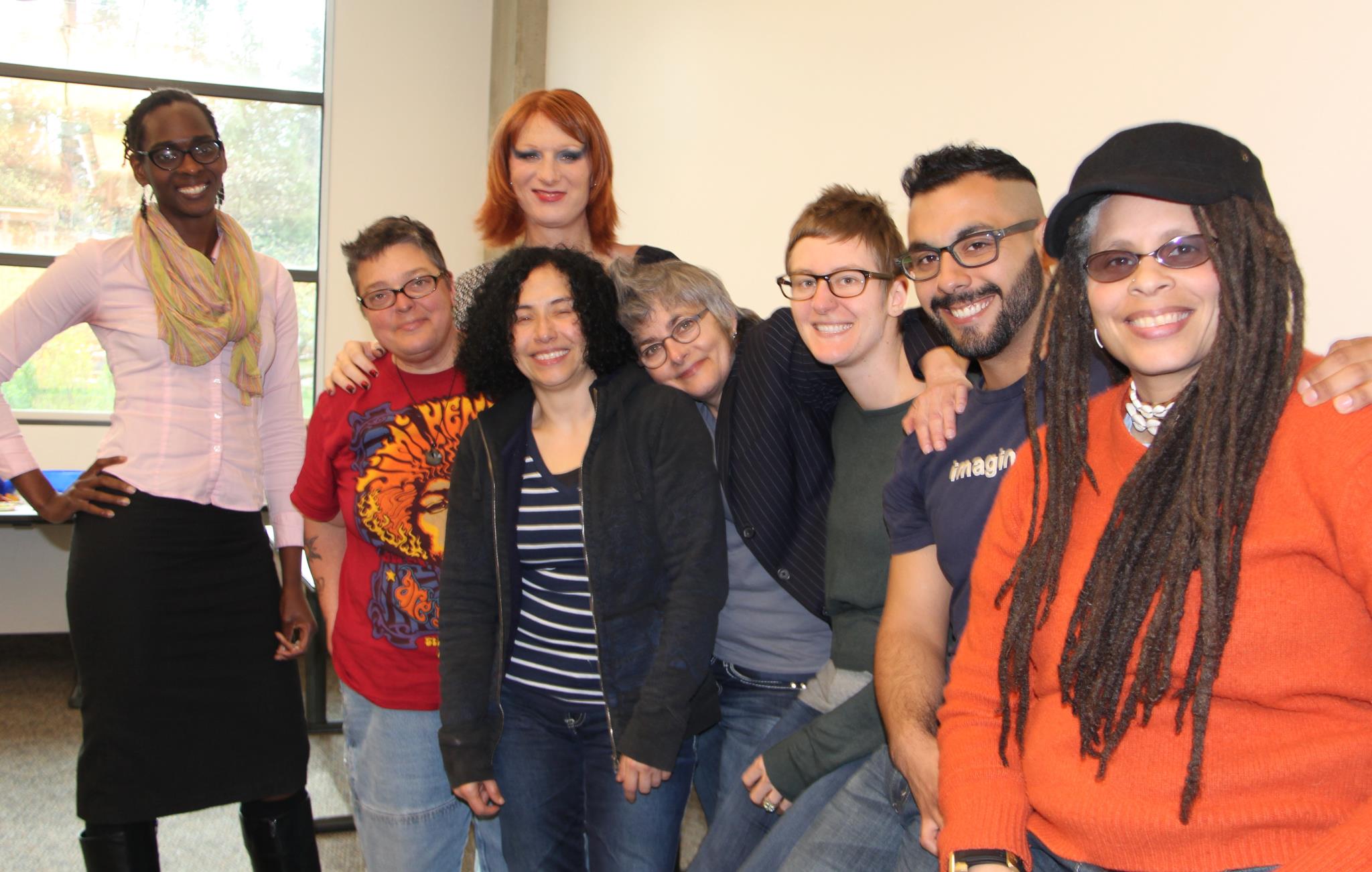
Pictured are our Digital Storytellers: Isis Asare, Mian Carvin, Margaret Elisabeth, Jacque Larrainzar, Fia Gibbs, Petra Davis, Caleb Hernandez and Jourdan Keith.
Submit a Proposal for Queering the History Museum Symposium
The Queering the History Museum Symposium is coming up fast! Tickets for the June 8, 2013 event at the Museum of History and Industry are already on sale here!
Currently we are asking community members, history enthusiasts, activists, artists, academics and professionals who are interested in sharing their knowledge and passion about representation, museums, history or any combination of these topics to lead sessions at the symposium. All the details about the proposals are included in the Request for Proposals.
Submissions must be received by May 1, 2013. Send us your great ideas at queeringthemuseum@gmail.com. We can’t wait to see what you come up with!
 Queering the Museum Project